
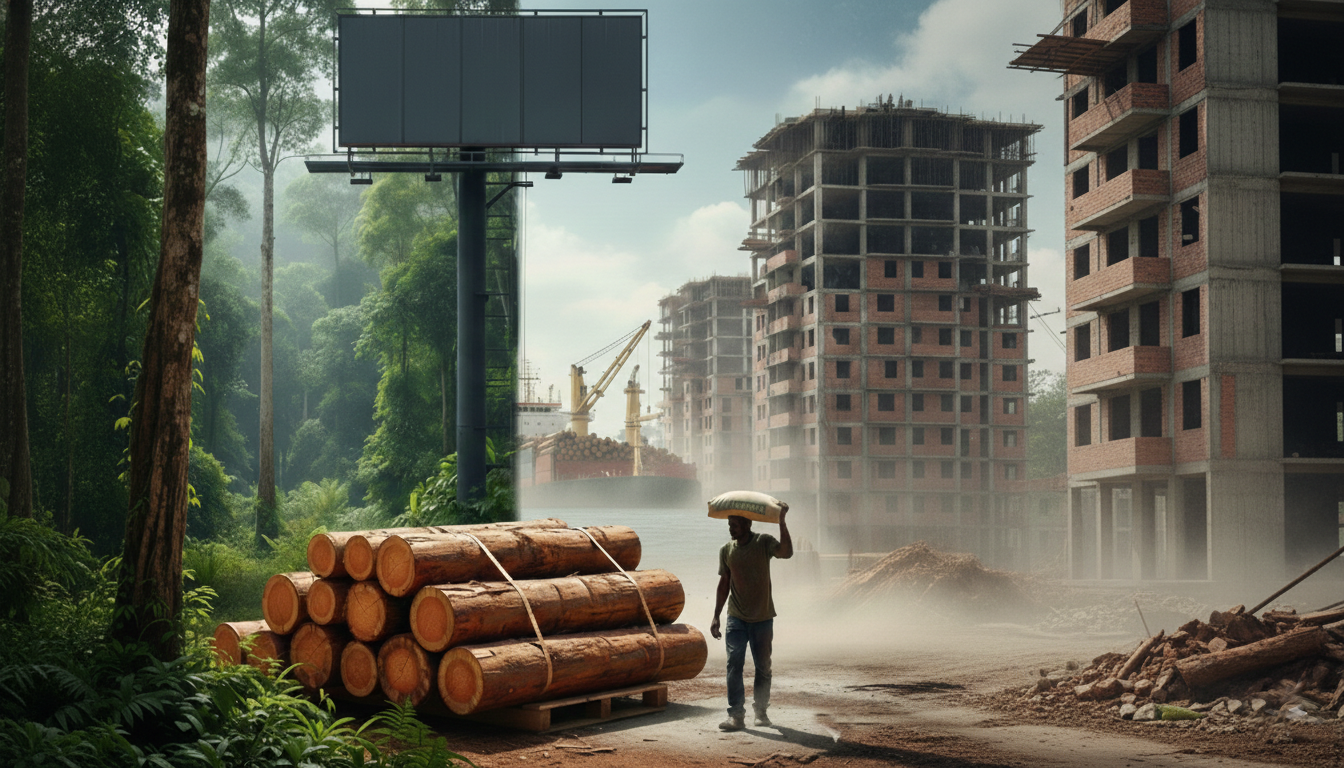


Walk through the streets of Kigali, Nairobi, or Kinshasa, and you'll notice something peculiar. The skyline is dominated by concrete towers and rust-colored brick. The air carries that distinctive orange dust that settles on everything. Now glance at a satellite map of the region. Wait aren't we surrounded by some of the planet's most magnificent forests? The irony is striking. While architects in Stockholm and Vancouver compete to build the tallest wooden skyscrapers, celebrating timber as the construction material of the future, countries sitting on vast forest wealth continue pouring concrete. What's going on here?
The answer isn't about laziness, ignorance, or lack of environmental awareness. It's about two powerful economic forces and a missing industrial revolution that nobody talks about.
Why You Can't Just Build with Trees
Let's start by busting a popular myth: you can't just walk into a forest, cut down a tree, and build a house. Well, you can, but you probably shouldn't. Here's the thing fresh-cut timber is basically a water balloon. "Green wood" (industry speak for freshly harvested timber) can contain 50% moisture or more. Build a house with it, and you're in for a wild ride as your walls shrink, your floors buckle, and your door frames twist themselves into modern art installations.
Professional construction requires timber dried to around 12-15% moisture content. Getting there demands massive industrial kilns that can handle thousands of board-feet at once, maintaining precise temperature and humidity levels for weeks. It's not cheap, and it's not simple. Many developing nations simply haven't built this infrastructure yet. Without it, that "free" timber from nearby forests becomes a liability rather than an asset.
Then there's the termite problem. In tropical climates, untreated wood is essentially an all-you-can-eat buffet for insects and fungi. Modern timber construction relies on sophisticated pressure-treatment processes that force preservatives deep into the wood's cellular structure. Done right, treated timber can outlast concrete. Done wrong or not at all and your building might not survive five years.
The real game-changer, though, is engineered wood products like Cross-Laminated Timber (CLT). Think of it as plywood on steroids. By gluing layers of wood at perpendicular angles under extreme pressure, manufacturers create panels that can compete with steel in strength-to-weight ratios. You can build 18-story buildings with this stuff. But producing CLT requires robotics, precision engineering, and significant capital investment. Without local factories producing these advanced materials, concrete remains the path of least resistance.
The Mahogany Paradox: Exporting Wealth, Importing Houses
Now for the economic twist that makes this situation particularly maddening. Many timber-rich nations are caught in what we might call the "mahogany paradox." Here's how it works: a country desperately needs foreign currency to import everything from medical equipment to smartphones. Raw logs fetch excellent prices on international markets, paid in dollars or euros. So the finest mahogany, teak, and eucalyptus gets loaded onto ships bound for China, Europe, or North America.
Meanwhile, local builders who want quality timber face a bizarre situation. They're bidding against international buyers who have deeper pockets and pay in harder currency. The premium wood gets exported, processed in distant factories, and sometimes even returns as expensive finished products. A contractor in Kinshasa might find that Indonesian plywood (possibly made from African trees) costs less than locally-sourced timber processed to international standards.
This creates a perverse outcome: in countries covered by forests, a bag of cement becomes the economical choice. Concrete doesn't need drying, doesn't attract termites, and isn't competing with export markets. It's predictable, available, and crucially cheaper for the immediate need, even if its carbon footprint is astronomical.
How America Built Its Timber Revolution (And It Wasn't Just About Having Trees)
History offers an interesting lesson here. The United States didn't become a timber construction powerhouse just because it had forests. In the mid-1800s, America was a developing nation experiencing explosive urban growth and a serious housing crisis. The East Coast was being stripped of trees, and traditional timber-frame construction—where skilled craftsmen painstakingly fitted hand-hewn beams with complex joints couldn't possibly keep pace.
Enter the industrial revolution's unsung hero: the mass-produced nail. Sounds boring, right? But cheap nails changed everything. They enabled "balloon framing," a construction method so simple that semi-skilled laborers could erect a house frame in days rather than months. Instead of massive timbers joined with intricate carpentry, builders used thin, standardized boards nailed together. The frames looked flimsy (hence "balloon"), but they were surprisingly strong.
This innovation didn't happen in isolation. Steam-powered sawmills could process timber at unprecedented scales. Railways were specifically built to move lumber from forests to cities. Crucially, America developed grading systems that standardized lumber quality. A 2x4 wasn't just any piece of wood—it was a precisely dimensioned product with known strength characteristics. This standardization let builders calculate loads, plan structures, and trust their materials.
In other words, America built an entire industrial ecosystem that transformed a biological resource into a reliable construction commodity. The forests provided raw material, but the "machine" that complex system of processing, transportation, standardization, and regulation made wood construction viable at scale.
Building the Missing Middle: From Forest to City
This historical example illuminates the path forward. For timber-rich nations to leverage their natural advantage, they need to build the missing middle: the industrial infrastructure between forest and city. This means investing in kiln-drying facilities sized for local demand, establishing pressure-treatment plants, and creating domestic production capacity for engineered wood products.
Equally important is the regulatory framework. Building codes need updating to recognize and permit modern timber construction techniques. Grading standards ensure quality and enable planning. Professional training programs teach architects and engineers to design with timber. Insurance companies need frameworks for evaluating timber structures.
There's also a crucial policy dimension around export controls and value-added processing. Several countries have experimented with bans or taxes on raw log exports, requiring at least basic processing domestically. Indonesia, for example, banned raw rattan exports, forcing buyers to purchase finished rattan furniture instead. The results were mixed—enforcement proved challenging but the principle is sound: capture more value locally before resources leave the country.
The Economic Case for Green Gold
The financial case is compelling. Processing timber domestically creates jobs across the skill spectrum, from kiln operators to engineers. It reduces foreign exchange pressure by substituting local materials for imported cement and steel. It enables a construction industry with lower carbon emissions, potentially opening doors to green financing and carbon credits. And it builds industrial capacity that can serve both domestic needs and export markets for finished products.
Perhaps most importantly, it offers a development pathway that aligns economic growth with environmental sustainability. Managed forests where trees are harvested sustainably and replanted can become perpetual resources rather than depleted assets. Modern forestry, when done properly, can actually increase carbon sequestration while providing economic value.
The concrete skylines of Nairobi, Kigali, and Kinshasa aren't inevitable. They're the result of specific economic incentives and missing infrastructure. The forests surrounding these cities represent not just environmental assets but potential industrial foundations. The question isn't whether these countries have the resources to build differently they clearly do. The question is whether they can build the industrial systems that transform those resources from exports into the literal building blocks of sustainable, prosperous cities. The timber is there. The technology exists. What's needed is the industrial revolution that connects the two.