
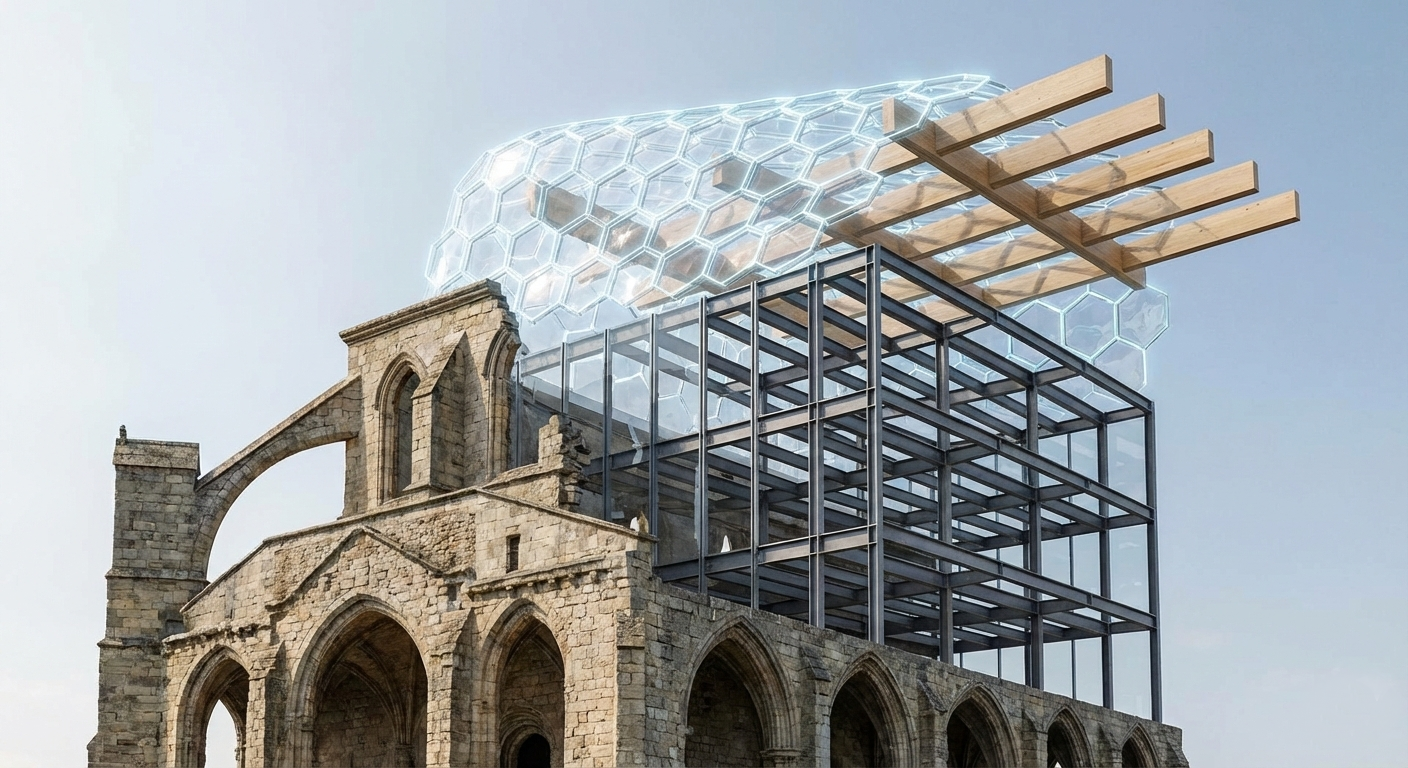


What Really Keeps Skyscrapers From Falling Down (And Why Ancient Buildings Refuse to Die)
Ever crane your neck at a skyscraper and feel that little flutter of existential dread? Completely normal. You're staring at thousands of tons of concrete, glass, and steel balanced on what looks like a few narrow columns, and some primitive part of your brain is screaming that this violates the laws of physics. Spoiler alert: it doesn't, and the reason why is actually pretty fascinating.
The game-changer was steel. Before we figured out how to mass-produce it in the late 1800s, building tall meant building thick. Castles, pyramids, medieval towers they all stayed upright through sheer bulk. They're essentially sophisticated piles of heavy rocks that win through stubbornness alone.
Steel flipped the script entirely. Unlike stone or brick, which are excellent under compression (squeezing) but pathetic under tension (pulling), steel absolutely excels at being pulled. Standard structural steel can handle around 50,000 pounds per square inch. That means you could theoretically stack a dozen school buses on a single square inch and the steel would just sit there, unimpressed. This tensile strength is why we can build structures that are mostly empty space those soaring atriums and floor-to-ceiling windows aren't just aesthetically pleasing, they're structurally possible because steel forms a skeleton that doesn't need thick walls to support itself.
There's another superpower steel brings to the table: ductility. In an earthquake, a steel-framed building will actually sway and flex, absorbing seismic energy like a spring. A rigid masonry structure? It just cracks and crumbles. This is why modern building codes in seismic zones basically worship steel and engineered flexibility.
But here's the thing that trips people up: if steel is so superior, why is the Colosseum still standing after two millennia while half the concrete parking garages from the 1970s are already falling apart?
The Romans didn't have steel, but they had something arguably cooler: empirical genius combined with accidental chemistry. Their structural secret weapon was the arch. Picture two people leaning against each other at precisely the right angle they're both falling, but falling into each other with such perfect balance that they stay upright. Roman arches work the same way. The weight of the structure above actually compresses the voussoirs (those wedge-shaped stones) tighter together. The heavier the load, the stronger the arch becomes. It's a self-reinforcing system that turns gravity into an ally rather than an enemy.
Their concrete was even more remarkable, though they didn't fully understand why. They mixed volcanic ash from Vesuvius into their concrete particularly pozzolana, a specific type of volcanic material. When this mixture came into contact with seawater, it triggered a chemical reaction that produces aluminum tobermorite crystals. These crystals grow into microscopic cracks over time, meaning Roman concrete literally gets stronger as it ages. Modern Portland cement concrete starts degrading after 50 years. Roman seawater concrete is still mineralizing and strengthening after 2,000 years. They accidentally created a self-healing material that we're only now beginning to understand and replicate.
Fast forward to the Gothic period, and medieval builders hit a different constraint. They wanted soaring ceilings and massive stained-glass windows to create those ethereal, light-filled interiors, but the weight of stone vaulted roofs created enormous lateral thrust outward pressure that wanted to push the walls over like dominoes.
Their solution was the flying buttress, those distinctive stone arms reaching out from the sides of cathedrals like Notre-Dame. They're essentially external load-bearing structures that redirect the lateral thrust from the roof vaults downward into the ground. They turned a collapsing outward force into a stabilizing downward one. Structurally, they're elegant. Architecturally, they became iconic. Functionally, they allowed medieval masons to build impossibly thin walls punctuated by enormous windows all without steel.
So what's next? Is steel the endpoint of structural evolution? Not remotely.
Superwood is turning timber into a high-performance structural material through a process called densification. Researchers strip out lignin (the natural binding compound in wood) and compress the remaining cellulose fibers under extreme pressure and heat. The result is a material that's ten times stronger than natural wood, comparable to steel in some applications, and yes actually bulletproof. Mass timber construction using cross-laminated timber (CLT) and glued-laminated timber (glulam) is already allowing wood buildings over 18 stories tall. The carbon sequestration benefits are substantial, and the material is renewable. We might genuinely see wooden skyscrapers competing with steel frames within the next decade.
Graphene is the material that gets materials scientists genuinely excited. It's a single-layer lattice of carbon atoms basically two-dimensional material and it's about 200 times stronger than steel while being incredibly light. The problem is cost and scalability. We can't build a whole structure from graphene yet, but we're starting to use it as an additive. Mix small amounts of graphene into concrete or steel, and you dramatically improve strength-to-weight ratios and durability. It's like adding a performance-enhancing supplement to traditional materials.
Self-healing concrete is perhaps the most Roman thing we're doing in modern construction. Researchers are embedding dormant bacterial spores (usually Bacillus species) into concrete along with a nutrient source like calcium lactate. When cracks form and water penetrates, the bacteria activate, metabolize the nutrients, and precipitate calcium carbonate limestone which fills the cracks. The building literally repairs its own damage autonomously. We took a 2,000-year-old Roman accident and turned it into intentional design.
The trajectory here is clear: we're moving from brute-force solutions to intelligent systems. Ancient builders used mass and geometry because those were their available tools. Modern engineering added material science steel, reinforced concrete, composite materials. The next phase integrates responsiveness and adaptation. Buildings that sense stress and redistribute loads. Materials that repair damage without human intervention. Structures that sequester carbon rather than emit it.
The skyscraper you're nervous about? It's held up by mathematics, material science, and a century of iterative engineering refinement. The Colosseum? Geometry, empirical knowledge, and accidental chemistry. Both are marvels. Both represent the cutting edge of their respective eras. And both point toward a future where our buildings are simultaneously stronger, lighter, smarter, and more sustainable than anything we've built before.
That flutter of dread when you look up at a tall building? Keep it. Healthy respect for forces and materials is what drives good engineering. But rest assured: those buildings aren't standing on faith. They're standing on physics, and physics is pretty reliable.