
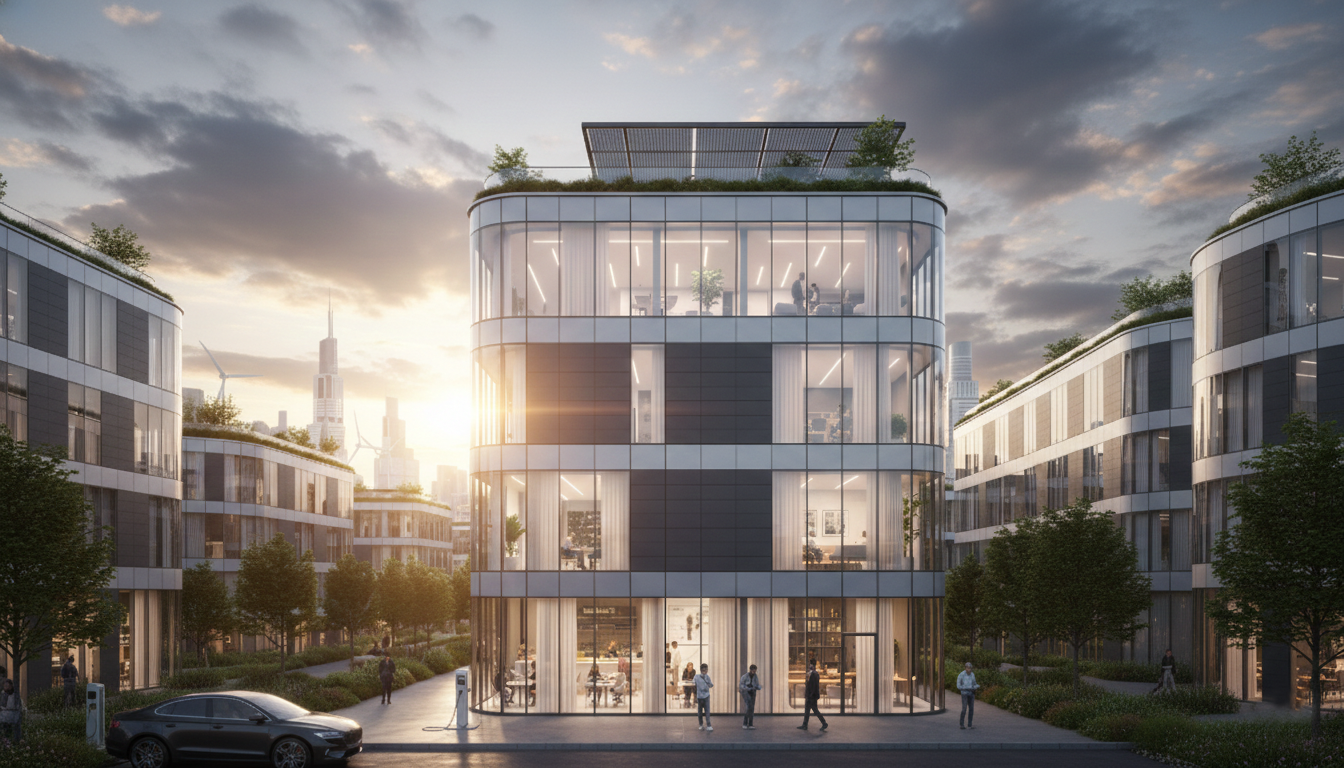


Whether you are a tech enthusiast, an architect, or someone just looking to lower their electricity bill, you’ve likely seen traditional solar panels: those bulky, blue-tinted rectangles bolted onto roofs.
But what if the building itself was the solar panel? This is the core idea behind Building-Integrated Photovoltaics (BIPV). In this blog, we’ll dive into what BIPV is, how it evolved from a niche 70s experiment into a modern architectural staple, and where the tech is headed in 2026 and beyond.
What exactly is BIPV?
While traditional solar panels are "bolted on" (technically called BAPV Building-Applied Photovoltaics), BIPV materials are the actual building blocks. Instead of choosing between a window and a solar panel, you install Solar Glass. Instead of laying down shingles and then covering them with panels, you use Solar Tiles.
The "magic" of BIPV is that every component serves two functions: it acts as a Protective Skin (providing weatherproofing and insulation) and a Power Plant (generating clean electricity).
The Evolution: From Niche to Necessity
The journey of BIPV began in the 1970s as a purely functional, often clunky solution for off-grid structures. These early modules were essentially standard panels "glued" to buildings rather than truly integrated. However, the 1990s sparked an architectural awakening in Europe, where designers began experimenting with semi-transparent solar glass to prove that energy generation could be a deliberate design feature.
Today, we have entered the "Invisible Era." Technological breakthroughs in the 2010s and 2020s have allowed manufacturers to camouflage solar cells behind textures that mimic traditional slate, terracotta, or sleek metallic cladding.
Beyond efficiency, the future is literally clear. New developments in Luminescent Solar Concentrators use "quantum dots" to capture specific wavelengths of light and funnel them to the edges of a window frame where tiny solar cells are hidden. This means every window in a high-rise could act as a transparent power plant without obstructing the view.
How "Solar Walls" Actually Work
When people say "solar panels inside walls," they are usually referring to Solar Facades. There are two main ways this is achieved:
- Thin-Film Integration: A thin layer of photovoltaic material is sprayed or laminated directly onto cladding materials like aluminum or steel.
- Spandrel Glass: In large office buildings, the opaque glass between floors is replaced with solar glass. Since this glass doesn't need to be transparent, it can be packed with high-efficiency cells hidden behind colored finishes.
The Invisible Revolution: Turning Cities into Solar Forests
As we look toward the next decade, the focus of BIPV is shifting from "how much can we hide" to "how much can we harvest." We are moving toward active, intelligent skins capable of capturing light from every angle, even in low-light urban environments.
This shift is being accelerated by policy. As of May 2026, the EU Solar Standard requires all new commercial and public buildings over 250m² to integrate solar energy systems. This is no longer just a design choice it is a regulatory mandate.
BIPV vs. Perovskites: The Core Distinction
It is important to clarify the difference between these two terms. BIPV refers to the application—the concept of solar built into a wall or window. Perovskite refers to the material the actual chemical engine that turns light into power. While older BIPV relied on rigid silicon, the advent of perovskites is what finally makes "solar skin" possible.
The Rise of Perovskites
Perovskites are synthetic materials with a unique crystalline structure that can be printed or sprayed onto surfaces. By layering a thin perovskite film on top of a standard silicon cell a method known as a Tandem Cell manufacturers in 2026 are pushing efficiency limits toward 30%. This makes solar walls viable even on the shaded sides of skyscrapers, where traditional silicon would struggle to generate enough power to be cost-effective.