
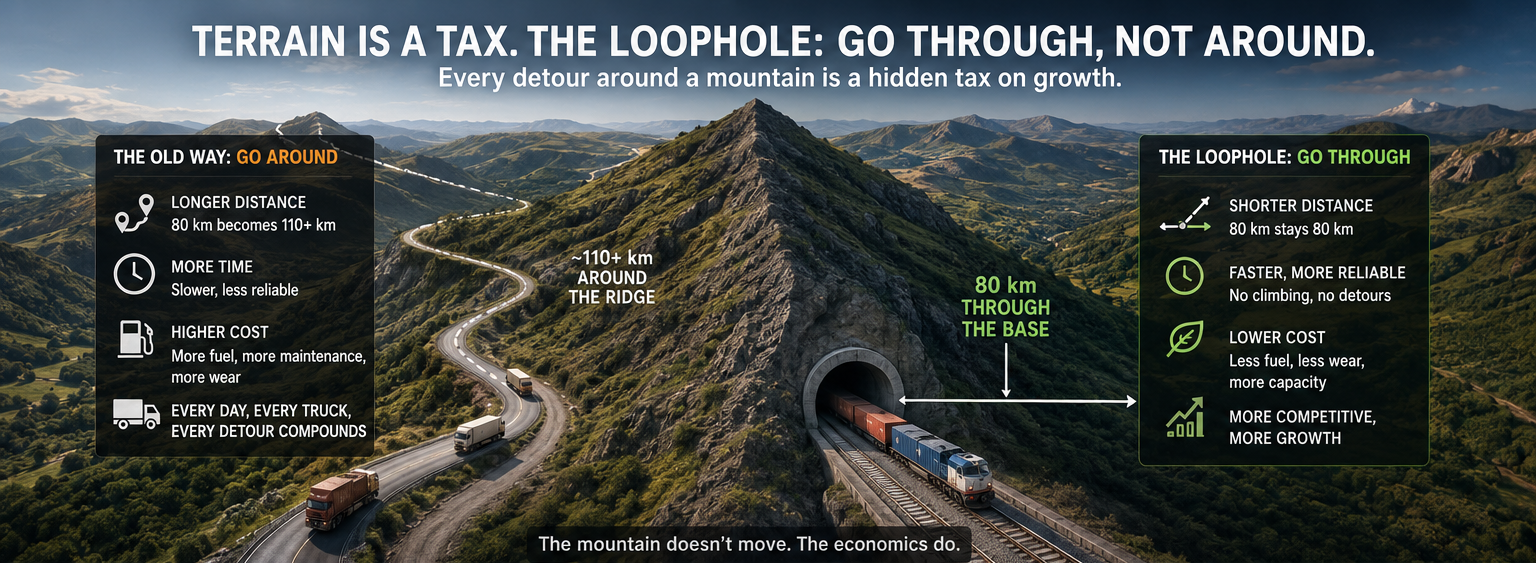


Every time a truck leaves Kigali for Musanze, it pays a tax nobody voted for.
Not a customs fee. Not a fuel levy. A geographic one. The road doesn't go straight it can't. A ridge sits between the two cities, and the road does what roads have done for centuries: it bends around it. What should be an 80-kilometre journey becomes longer, slower, and more expensive. Multiply that by every truck, every bus, every delivery, every day and you start to see the bill.
This is what economists call the cost of terrain. And across much of Africa, it is one of the largest hidden taxes on economic growth that nobody is talking about.
The old deal with mountains
For most of human history, geography was non-negotiable. You built your city on the plain, your trade route through the valley, your railway up the gentlest slope available. Mountains were walls. You went over them, around them, or you didn't go at all.
When railways arrived in the 19th century, engineers struck a compromise: the summit tunnel. Bore a hole near the top of the pass, let the train climb to reach it, then descend on the other side. It worked. But "working" and "optimal" are different things.
The old Mont Cenis tunnel between France and Italy opened in 1871 sits at over 1,300 metres above sea level. Trains climbing to reach it burn 40% more energy than they would on flat ground. The gradient is so steep that each freight train is capped at 600–700 tonnes. For 150 years, that was simply accepted as the cost of crossing the Alps.
Then someone asked a different question: what if the tunnel didn't go over the mountain what if it went through the base of it?
The loophole
A base tunnel doesn't negotiate with the mountain. It ignores it entirely.
Instead of climbing to meet the terrain, it bores horizontally through the rock at the lowest possible elevation connecting two valleys on either side without the train ever needing to gain altitude. The gradient drops from punishing to almost flat. Energy costs fall. Freight capacity doubles. Journey times collapse.
The Lyon–Turin Base Tunnel, currently being drilled beneath the Alps between France and Italy, is the most ambitious version of this idea alive today. At 57.5 kilometres long, it bores at just 570–750 metres above sea level. Its gradient is 1.2% compared to 30% on the old line. One train on this route carries what 60 trucks do on a road. It is, in the most literal sense, infrastructure that stops paying the terrain tax.
The price tag is real: €11.1 billion for the tunnel alone, with the full 270-kilometre Lyon–Turin rail link estimated at €25 billion, split between the EU, Italy, and France. Completion is set for 2033. But reframe the number: this is not a transport project. It is an anchor asset the kind that bends an entire region's economic trajectory toward itself for the next century. The kind Sequoia 27 explored in The Gravity of Grandeur.
Africa already has the proof
Here is where the story gets interesting and where the conventional narrative about African infrastructure falls apart.
Africa has not been waiting for permission to do this. It did it in 1989.
In South Africa's Western Cape, the Cape Fold Belt a dramatic mountain range had separated Cape Town from the interior of the continent since the first colonial railways were built in the 1870s. The original line had to wind laboriously over the Hex River Pass, adding distance, time, and gradient penalty to every single journey between Cape Town and Johannesburg. For over a century, that was the deal.
Then South Africa built the Hex River Tunnels: four tunnels through the base of the mountains, with 16.8 kilometres of the 30-kilometre route running underground. The new direct line, opened in 1989, eliminated a 25-kilometre loop of old railway that had existed since 1877. The mountain didn't move. The economics did.
That is base tunnel logic, executed in Africa, over 35 years ago. It is not a European idea. It is a geometric one and the geometry works wherever mountains meet ambition.
More recently, Kenya built the 7.14-kilometre Ngong tunnel as part of its standard gauge railway from Nairobi to Naivasha, becoming the second African country with a significant railway tunnel. In Guinea, the TransGuinean railway through the Simandou Mountains will include over 24 kilometres of tunnels the longest spanning 11 kilometres to access one of the world's largest untapped iron ore deposits. In Lesotho and South Africa, two tunnel boring machines are currently drilling a 38.5-kilometre tunnel through the Maluti Mountains for the largest water transfer project in African history.
The machines exist. The expertise is on the continent. The geology volcanic and metamorphic rock across much of East Africa is, in engineering terms, excellent tunnelling ground.
So why is Rwanda still going around the mountain?
Rwanda has invested seriously in its roads. The tarmac is good by regional standards. The government is competent and strategically minded Kigali Innovation City, which uses universities and tech companies as knowledge anchors, is proof of that ambition translated into built form.
But Rwanda has no railways. And its roads, however well-maintained, are permanently sentenced to bend around the same ridges they have always bent around. The country sits on the Albertine Rift a tectonic upheaval that produces relentless elevation change across a territory smaller than the state of Maryland. Every key route pays the terrain tax, every day.
The case for Rwanda is not a single Alpine-scale mega-tunnel. It is something more surgical: a network of short tunnels 2 to 5 kilometres each punching through the five or six ridge crossings that impose the highest penalties on the most economically significant routes. Kigali to Musanze. The Congo-Nile divide. The eastern corridor toward Tanzania.
Each intervention is modest in isolation. Collectively, they restructure the country's internal connectivity in a way that no road resurfacing programme ever could. And at 2–5 kilometres, these are not €11 billion projects. They are the kind of targeted infrastructure bets that regional development banks the African Development Bank, JICA, the EU's connectivity funds are increasingly equipped to back.
The framing problem
The real obstacle is not engineering. It is not even financing. It is how the conversation is framed.
Infrastructure in Africa is almost always discussed as gap-filling: building what developed countries already have, as efficiently as possible. That logic produces roads that bend around mountains, because straight tunnels feel like a luxury. It optimises for the cost of building, not the cost of not building.
Base tunnel thinking runs on different logic the same logic behind every successful anchor asset. It asks: what single intervention, placed correctly, creates the conditions that make everything else viable? It builds for the economic geography of the next fifty years, not the budget constraints of the next five.
South Africa understood this in 1989. The question is whether the rest of the continent applies that lesson to connectivity not just to mining corridors and water pipes, but to the everyday economic arteries that determine how fast people, goods, and opportunity can move.
The verdict
The terrain tax is real, it compounds daily, and it is not inevitable.
Africa has already proven it can drill through mountains. It has the geology, the growing pool of engineering expertise, and increasingly the financing frameworks to do more. What it needs is for the people designing, funding, and advocating for infrastructure to stop treating tunnels as extravagance and start treating unnecessary detours as the true cost.
Because every kilometre a truck drives around a mountain that it could have driven through is not just a fuel cost. It is a small, daily subtraction from the economic potential of everyone on the other side.
The loophole exists. Some countries found it decades ago. It is a small, daily subtraction from the economic potential of everyone on the other side。